
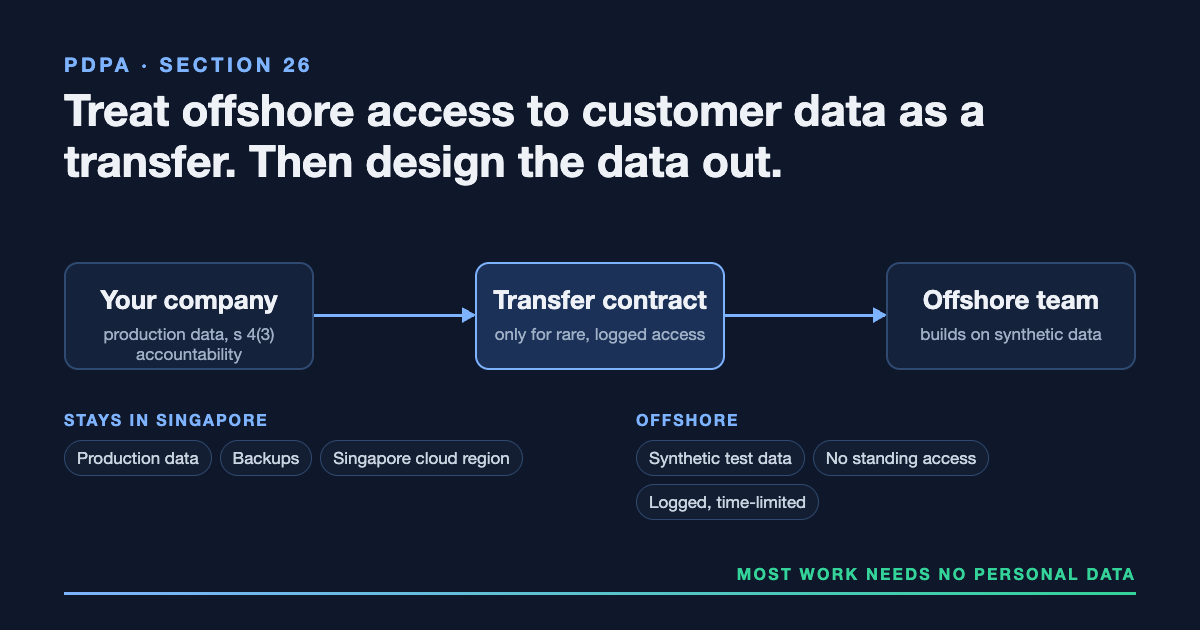
Yes, a Singapore company can give an offshore development team access to its systems under the Personal Data Protection Act (PDPA). The Act doesn't ban offshore teams.
Its overseas transfer rule, section 26, applies only when personal data leaves Singapore. The safe reading, explained below, treats a vendor's engineers reaching it from abroad the same way.
So the real question is whether your developers can reach personal data. Personal data means information about an identifiable person, such as a customer's name, phone number or order history. If they can, section 26 needs a contract (or a certification the vendor holds) in place first. If they can't, most of it never applies.
PDPA overseas transfer requirements
The PDPA overseas transfer rule is short: personal data may leave Singapore only if it keeps protection comparable to the PDPA's. Section 26(1) says an organization "must not transfer any personal data to a country or territory outside Singapore" except under prescribed requirements that ensure it (Personal Data Protection Act 2012, 2026). The Transfer Limitation Obligation is the name the regulator, the Personal Data Protection Commission (PDPC), gives this rule.
The Personal Data Protection Regulations 2021 fill in the detail. Before transferring, you must take "appropriate steps" to ensure the recipient is bound by legally enforceable obligations (regulation 10(1)). Those obligations must protect the data to a standard "at least comparable" to the Act. They can come from a law, a contract, binding corporate rules inside a group, another legally binding instrument, or a specified certification the recipient holds (regulations 11 and 12). A few narrow exceptions, such as informed consent, also count.
Looking for a PDPA "transfer impact assessment"? The Act doesn't use the term; the "appropriate steps" in regulation 10(1) are that due diligence.
For a buyer, the rule means four jobs. Decide whether the team needs personal data at all, and sign a transfer contract for the access that remains. Then check any certification the vendor claims and set up the breach-notice chain. The PDPC's Guide to Cross-Border Data Transfers and Advisory Guidelines on Key Concepts were both revised in April 2026.
Offshore developer access as a transfer
Treat any access your vendor's engineers have from abroad as a transfer. The PDPC says section 26 covers personal data going to another organization outside Singapore "in circumstances where it relinquishes possession or direct control" (Key Concepts, para 19.1, 2026). That includes a data intermediary processing it for you.
A vendor whose engineers in Kathmandu or Ho Chi Minh City can query, export or copy your customer data holds it abroad, beyond your direct control. The PDPC doesn't name remote access there, so this is our reading, and the safe one.
Your own staff are different. Under regulation 9, a "recipient" excludes the transferring organization's own employees. An employee traveling with a customer list on a laptop keeps the data under your control (para 19.1). A separate vendor company is a recipient. As illustrations:
- Engineers work on code, mock data and unit tests only: no transfer.
- Staging (a test copy of the live system) is seeded with production data: transfer.
- A support engineer can read the production database: transfer, even if they never export a row.
Takeaway: before signing anything, list every place the team could see personal data: databases, logs, error trackers, analytics, support tools and backups.
Does PDPA apply to foreign companies?
Yes, for what they do in Singapore. The PDPA covers organizations whether or not they're formed or based in Singapore, for personal data they collect, use or disclose in Singapore (Key Concepts, p. 22, 2026). But once you transfer data to an organization outside Singapore, the PDPC says that recipient "is not subject to the PDPA" (para 19.2).
That's why section 26 exists. The Act can't reach your vendor's office abroad, so the transfer contract is usually the only thing binding it to Singapore's standard.
Your own obligations stay put. Under section 4(3), you have "the same obligation" for data a data intermediary processes for you "as if the personal data were processed by the organisation itself". And you're responsible for the Transfer Limitation Obligation even when your Singapore vendor is the one moving data abroad (Key Concepts, Chapter 6, 2026).
Takeaway: you can't hand the obligation to a vendor. You can only buy promises from it, in writing.
PDPA data intermediary obligations
A data intermediary is an organization that processes personal data on behalf of another, such as a development vendor working under a written contract (Key Concepts, p. 24). Section 4(2) applies only three PDPA duties to one: protecting the data (s 24), not keeping it too long (s 25), and reporting breaches to you (s 26C(3)(a)).
An offshore vendor sits outside the Act (para 19.2), so your contract has to impose those duties instead. The PDPC's contract table sets the minimum: three areas for a data intermediary, eight for any other recipient.
| Area of protection in the contract | Data intermediary | Any other recipient |
|---|---|---|
| Purpose of collection, use and disclosure | ✓ | |
| Accuracy | ✓ | |
| Protection | ✓ | ✓ |
| Retention limitation | ✓ | ✓ |
| Policies on personal data protection | ✓ | |
| Access | ✓ | |
| Correction | ✓ | |
| Data breach notification | ✓ (tell you without undue delay) | ✓ (assess and notify, where relevant) |
Source: PDPC, Advisory Guidelines on Key Concepts, para 19.9, and Guide to Cross-Border Data Transfers (both 2026).
Whose contract it is matters as much as what's in it. In Toll Logistics (Asia) Limited and others [2022] SGPDPC 4, four Singapore group companies uploaded employee data to an Irish vendor's HR platform hosted in Europe. The Australian parent's contract with the vendor had data protection terms, but the Singapore companies weren't party to it. Their agreements with the parent were silent on data protection. The PDPC found a breach of section 26 and issued warnings.
The same case shows why vendor access matters: the attacker got in with credentials stolen from a third-party vendor that had administrative access (para 12).
Takeaway: the contract must name your Singapore company as a party. A parent company's or reseller's agreement isn't enough.
Transfer Limitation Obligation contract clauses
A transfer contract has two legal must-haves. Regulation 11(2) requires it to bind the recipient to protection "at least comparable" to the PDPA, and to "specify the countries and territories" the data may go to. For a data intermediary, add the three areas above.
For a development engagement, that minimum is thin. These clauses make it checkable. They're recommended practice, not PDPC text:
- Named environments where personal data may exist, such as production and one masked staging copy. Never laptops.
- Named countries: the vendor's office country plus every cloud region involved.
- Sub-processors: every freelancer, subcontractor and tool that touches the data, with your approval before changes.
- Access control: named accounts, multi-factor authentication on all remote access, logging, and quarterly access reviews.
- Breach notice in hours, with a named contact and a duty to help with your assessment.
- Exit: return or deletion of the data, confirmed in writing.
- Evidence: the right to see access logs, policies and audit results.
Where the vendor sits decides your starting template.
| Where the team is | Starting template |
|---|---|
| ASEAN (Vietnam, the Philippines, Malaysia, Indonesia) | ASEAN Model Contractual Clauses, which the PDPC recognizes and encourages (para 19.10) |
| Outside ASEAN (Nepal, India, Sri Lanka, Eastern Europe) | Your own clauses, guided by the China Standard Contract, EU Standard Contractual Clauses or Ibero-American model clauses (PDPC Guide, 2026) |
Signed before access starts, these terms are how you safeguard a data transfer to an outside provider in another country. The same agreement is where the IP assignment clause belongs.
Takeaway: ask the vendor for its standard data processing terms and mark them up against this list.
Global CBPR and PRP certification
A certification can replace the contract terms, but only if your vendor holds one. Under regulation 12, a recipient with a "specified certification" is taken to be bound to comparable protection. Since 2 March 2026 (S 86/2026), the Global versions count too. A data intermediary can rely on APEC or Global Privacy Recognition for Processors (PRP), or APEC or Global Cross-Border Privacy Rules (CBPR). Other recipients need APEC or Global CBPR.
The certification must be granted or recognized under the law of the vendor's country. On 30 September 2026, the Global CBPR Forum listed ten members, including the Philippines, Japan and the United States. Nepal, India, Vietnam, Sri Lanka, Pakistan and Bangladesh weren't members or associates. Check any claim against the Forum's list of certified organizations, as the PDPC's own examples do (para 19.8).
Takeaway: for most offshore development vendors, certification isn't available. Plan on the contract.
Consent and other transfer exceptions
Consent is legal but a poor fit for an offshore engagement. Regulation 10(2) also accepts deemed consent, such as a transfer needed to perform a contract with the person. It also covers vital or national interests (para 19.7), data only passing through Singapore, and data already publicly available in Singapore.
Consent has conditions. The person must first get "a reasonable summary in writing" of how their data will be protected abroad. You can't make consent a condition of your service unless the transfer is reasonably necessary to provide that service, and people can withdraw consent (regulations 10(3) and 10(4)).
Picture sending 40,000 customers a written summary and collecting their consent so a vendor can debug staging. The PDPC encourages these routes only when contracts or certifications aren't possible (para 19.7). It can also exempt a transfer on application (s 26(2)).
Takeaway: build the engagement on a contract, or on no personal data at all.
Development work without personal data
Most offshore development work needs no real personal data. Feature code, user interfaces, tests, CI pipelines (automated build and test runs) and staging can run on synthetic records or properly anonymized copies. If no personal data leaves Singapore, there's no overseas transfer, and section 26 never starts.
The PDPC says anonymized data is no longer personal data under the PDPA, subject to the conditions in its anonymization guidance (Key Concepts, p. 12, 2026). Re-identifying it without authorization can be an offense (s 48F). So what is not covered under the PDPA? For this purpose, mainly anonymized data and business contact information, such as a work email or job title not given solely for personal purposes (Key Concepts, p. 17).
Say you run a Singapore SaaS company with 40,000 customers and a six-person offshore team. As an illustration, access could split like this:
- Developers: synthetic seed data.
- QA engineer: a generated test dataset that mirrors real edge cases.
- One on-call engineer: production access that's off by default, time-limited, logged and reviewed. This is the only access the contract really has to cover.
- Logs and error reports: names, emails and phone numbers masked before they leave your cloud account.
Engineering mistakes happen onshore too. In Marina Bay Sands [2025] SGPDPC 6, one app identifier was missed in a software migration completed in March 2023. One employee had compiled the configuration by hand, with no second check. The gap stayed open for six months, data on 665,495 members was taken, and the penalty was S$315,000 (PDPC, 2025). Review security configuration like code.
Takeaway: count how many engineers truly need real data. The honest answer is usually one or none.
If you'd like help drawing that line, a free 30-minute scoping call can map which parts of your roadmap an offshore team can build without personal data.
PDPA data breach notification with vendors
When a vendor finds a breach, the PDPA sets up a relay. The vendor must tell you "without undue delay" (s 26C(3)(a)). You assess whether it's notifiable, generally within 30 calendar days (Key Concepts, para 20.4, 2026). If it is, you notify the PDPC as soon as practicable, and no later than 3 calendar days after that assessment (s 26D(1)).
The vendor doesn't assess or notify the PDPC; you do (para 20.8). A breach is notifiable if it's likely to cause significant harm, or affects 500 or more people (para 20.20).
Here's a worked example, an illustration with real clock arithmetic. Your vendor in Kathmandu (UTC+5:45) finds a problem at 4:30 pm on Thursday 12 November 2026. A staging database with a copy of 12,000 customer records was reachable from the internet. Singapore (UTC+8) is 2 hours 15 minutes ahead, so it's 6:45 pm there (see working with a Kathmandu team from Singapore). The Act names no hours for the vendor, so your contract sets them:
| Step | 24-hour vendor clause | 72-hour vendor clause |
|---|---|---|
| You hear by | 6:45 pm Fri 13 Nov | 6:45 pm Sun 15 Nov |
| Assessment done (example) | Wed 18 Nov | Fri 20 Nov |
| PDPC notified by | Sat 21 Nov | Mon 23 Nov |
If your assessment confirms a breach, 12,000 records make it notifiable on scale alone. The three days start the day after your assessment; in the PDPC's example, an assessment on 1 January means a 4 January deadline (footnote 78).
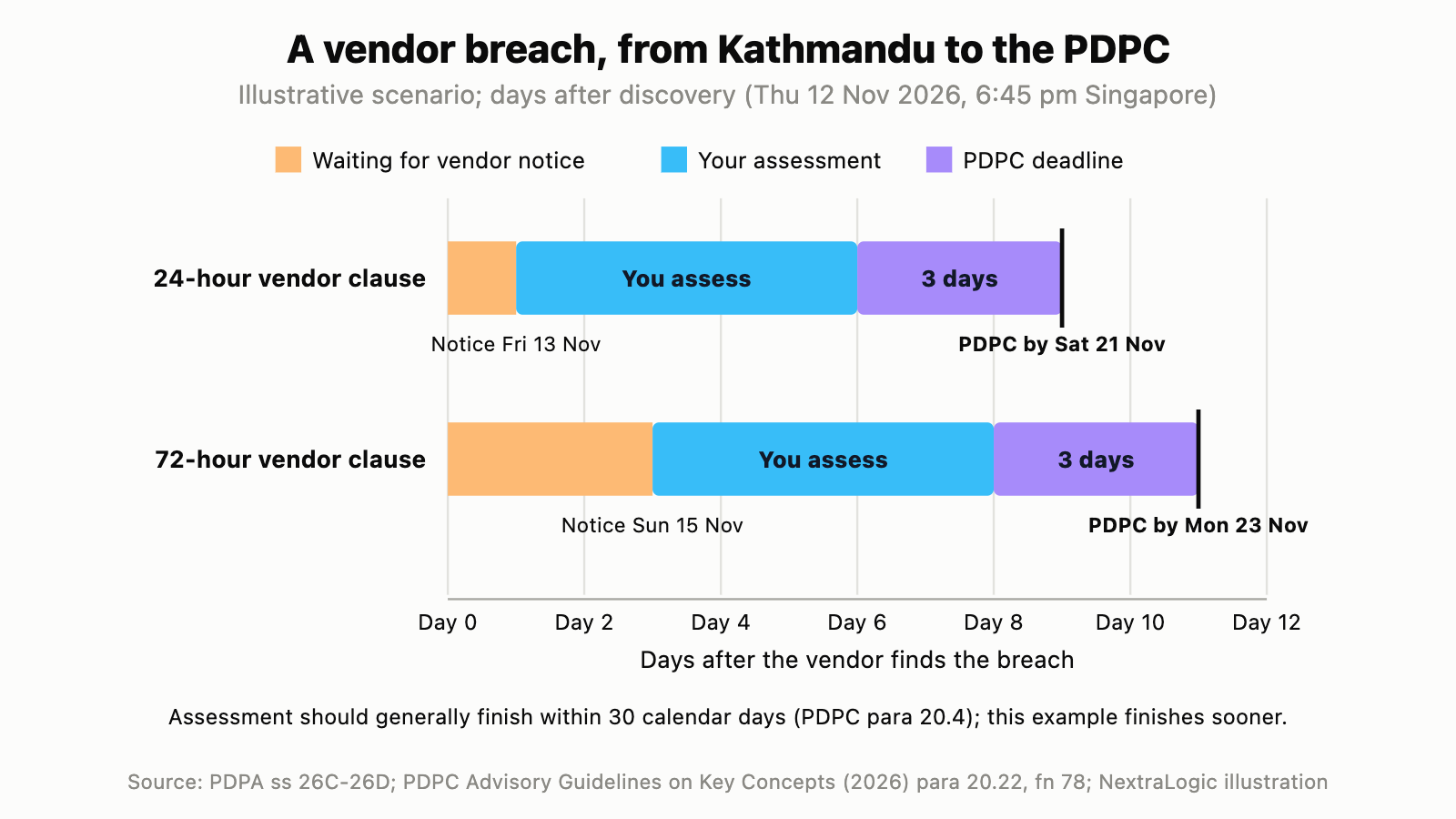
The vendor clause is the one number in this chain you control, and every hour of delay is an hour you can't act.
Takeaway: put a number of hours in the contract, not just "without undue delay".
PDPA penalties for companies
Under PDPA s 48J(3), the PDPC can impose a financial penalty of up to 10% of an organization's annual Singapore turnover if that turnover exceeds S$10 million. Otherwise the cap is S$1 million. The higher cap applies to breaches from 1 October 2022, using turnover from the latest audited accounts (s 48J(5A)).
So a company with S$25 million of Singapore turnover faces a ceiling of S$2.5 million (10% of S$25 million). One with S$8 million faces S$1 million.
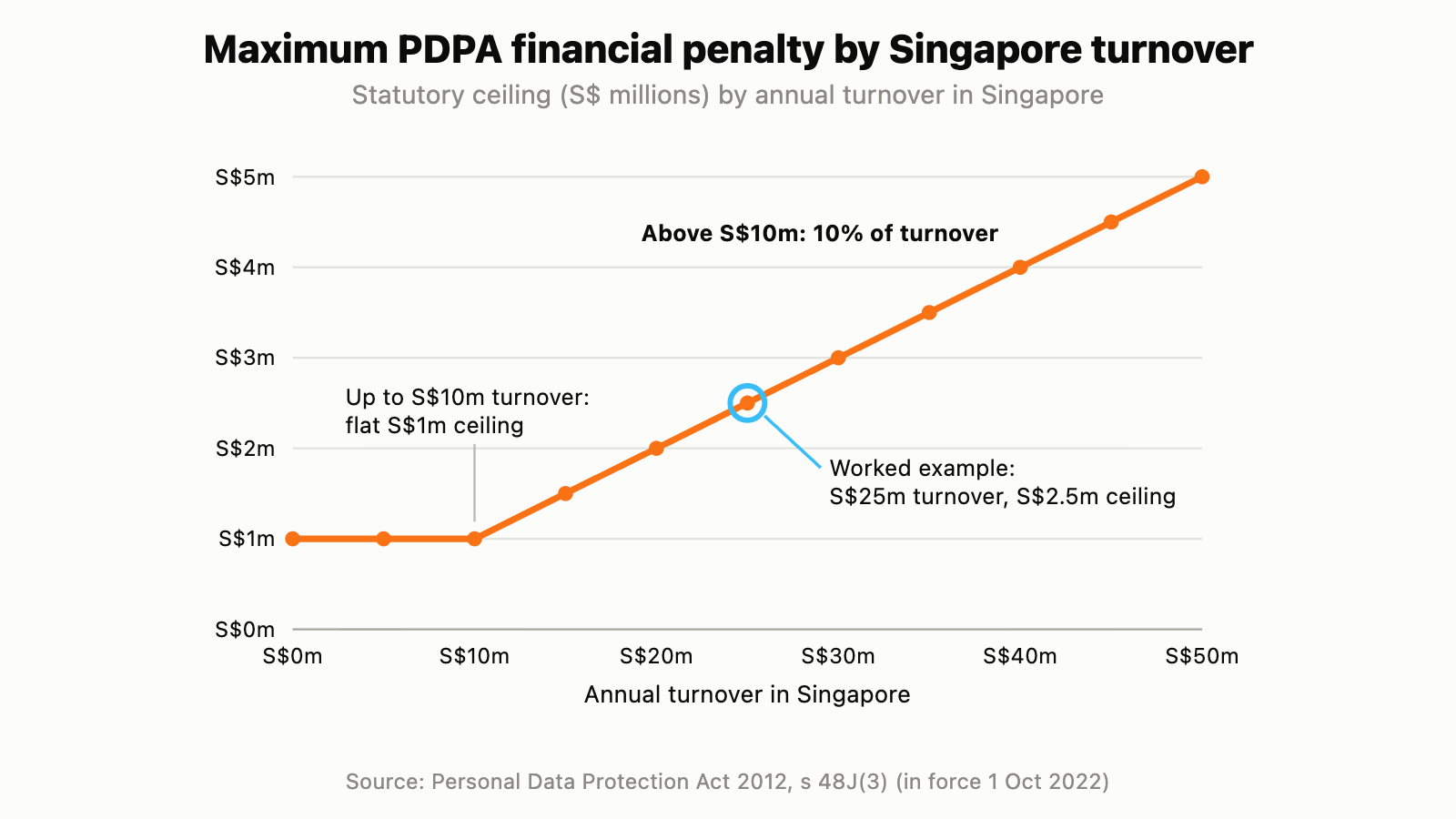
These are ceilings, not price lists; the Commission weighs harm, the type of data and how quickly you acted (s 48J(6)). Three real cases:
- Marina Bay Sands (2025): S$315,000 for the migration gap above.
- SingHealth and IHiS (2019): S$250,000 for SingHealth and S$750,000 for IHiS, its IT vendor (PDPC, 2019). A Singapore vendor can be fined directly; an overseas recipient sits outside the Act (para 19.2), which leaves the liability with you.
- Toll (2022): warnings, not fines, for the section 26 breach. Among other factors, the PDPC weighed the companies' cooperation, the absence of evidence of loss, and their new intra-group transfer agreements (para 28).
When offshore is the wrong choice
Some work belongs onshore: anything that needs broad, standing access to sensitive data, such as health records, NRIC numbers or financial details. There, an offshore team adds risk a contract can't remove. The same goes for a vendor that refuses the clauses above or can't name its subcontractors.
Check your own commitments too: enterprise contracts and sector rules may require data to stay in Singapore. And if nobody on your side will own the access reviews and breach runbook, the paperwork won't protect you.
PDPA overseas transfer checklist
Before an offshore team gets access:
- To do: Map where personal data lives: databases, logs, error trackers, analytics, support tools, backups.
- To do: Decide which roles need real data; give everyone else synthetic or anonymized data.
- To do: Mask personal data in logs and error reports.
- To do: Check any vendor certification against the Global CBPR Forum's list.
- To do: Sign a contract between your Singapore company and the vendor: comparable standard, named countries, protection, retention, breach notice in hours, sub-processors, deletion on exit.
- To do: Turn on multi-factor authentication and logging for all remote access.
- To do: Book quarterly access reviews.
- To do: Write a breach runbook with the PDPC deadline (as soon as practicable, 3 calendar days at most) and the vendor's contact.
- To do: Brief your Data Protection Officer and update your data protection policy.
Add these to your questions when vetting an offshore development partner. Serving EU customers too? The GDPR outsourcing requirements follow the same logic. Customers in Australia? APP 8 cross-border disclosure works the same way under the Privacy Act. Customers in California? The CCPA service provider contract requirements apply wherever the vendor sits. For how offshore engagements with a Nepal team work, see offshore development.
This is general information, not legal advice.