
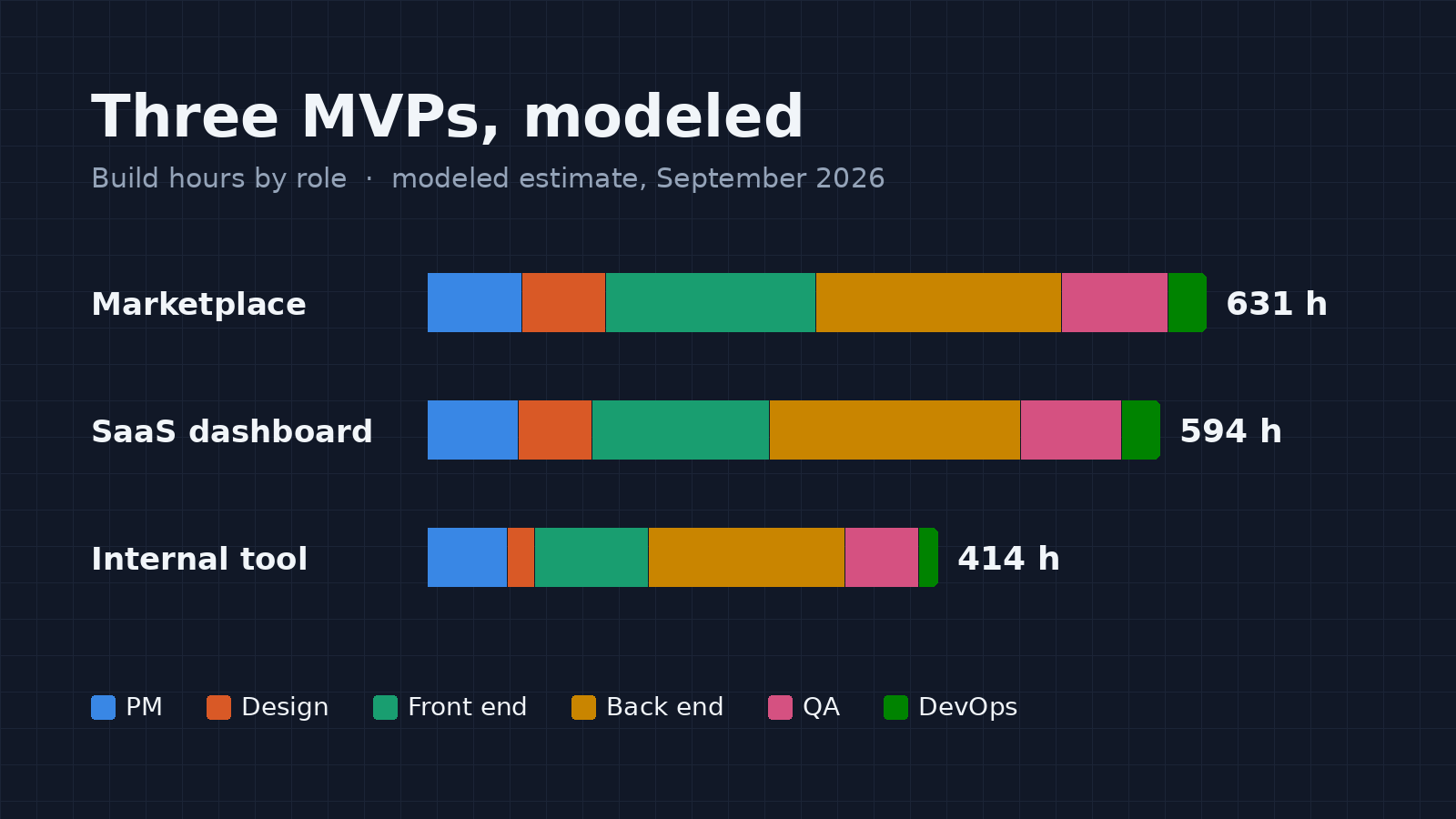
Most MVP cost guides give price ranges without showing the hours behind them. This one publishes the model instead, so you can check every number.
Building an MVP offshore costs roughly $15,000 to $27,000 with a senior team in Asia, depending on the product. With a senior team in Latin America or Central and Eastern Europe, the same work costs about 1.9 times as much. These are modeled estimates, not invoices.
An MVP, or minimum viable product, is the smallest version you can launch and learn from. Below are three scoped MVPs (a marketplace, a SaaS (subscription software) dashboard and an internal tool), broken down feature by feature with hours for each role.
How much does it cost to build an MVP offshore?
The three MVPs below need between 414 and 631 hours of work. At a senior Asia rate, that's $14,900 to $22,700, rising to $17,900 to $27,300 once you add 20% for the unknowns.
| Marketplace | SaaS dashboard | Internal tool | |
|---|---|---|---|
| Build estimate (hours) | 631 | 594 | 414 |
| Budget ceiling, +20% (hours) | 758 | 713 | 496 |
| Calendar time (weeks) | 9-10 | 9-10 | 6-7 |
| Asia senior, $36/h | $22,700-$27,300 | $21,400-$25,700 | $14,900-$17,900 |
| Latin America senior, $67.50/h | $42,600-$51,100 | $40,100-$48,100 | $27,900-$33,500 |
| Central & Eastern Europe senior, $70/h | $44,200-$53,000 | $41,600-$49,900 | $29,000-$34,700 |
| US in-house, loaded, $94/h | $59,400-$71,200 | $55,800-$67,000 | $38,900-$46,700 |
Modeled estimates, September 2026. Each range runs from the build estimate to the budget ceiling.
The offshore rates are midpoints of the senior developer bands in Accelerance's 2026 rate guide (November 2025). Those bands are $31-$41 an hour in Asia, $60-$75 in Latin America and $64-$76 in Central and Eastern Europe. Clutch's pricing guide (updated September 2026) puts most listed firms at $24-$49 an hour, so the Asia figure sits in the normal range.
The US row is what an in-house developer costs you per hour, not a vendor rate. It starts from the $135,980 median software developer wage (BLS Occupational Outlook Handbook, May 2025), or $65.38 an hour over 2,080 working hours.
Benefits are 30.8% of total compensation for private-sector professional jobs (BLS employer costs data, June 2026), so pay is the other 69.2%. That's the loaded rate: $65.38 ÷ 0.692, about $94 an hour. Our breakdown of what offshore software development costs, line by line shows that arithmetic.
How were these MVP budgets modeled?
Bottom-up. We listed the features each first version needs, wrote down what "done" means for each one, and estimated likely hours per role for a senior team.
That written checklist is called a definition of done. For payments, "done" might mean a customer can pay, get a refund, and the provider's payout adjusts. Without one, two vendors can quote the same feature name and price very different work.
Six roles share the hours:
- PM: the project manager, who plans the work and keeps you informed
- Design: screens and user flows
- Front end: the parts users see and click
- Back end: the server, database and connections to other services
- QA: testing, so bugs reach the team before they reach users
- DevOps: the pipeline and servers that get code live
Three lines in every table aren't features, though they count in the feature subtotal. Discovery and specs covers user flows, a prioritized backlog and wireframes. Foundations is the code repository, the pipeline that ships code, test and live servers, and backups. Launch readiness (Rollout for the internal tool) is the final checks and bug-fix round.
Two lines sit on top of the features. Project management adds 10% of feature hours, and features plus project management make the build estimate. Then 20% contingency makes the budget ceiling. Contingency works like the line in a kitchen renovation budget for whatever you find behind the walls.
Each region's rate applies to every role. That's a simplification, since some vendors bill each role at a different rate. The spreadsheet lets you set a rate for each role.
For calendar time, the model adds one or two weeks of discovery, then assumes one front-end and one back-end developer, each doing 30 focused hours a week. In all three MVPs the back end has the most hours, so it sets the pace. That's the critical path: the chain of work that decides the finish date. The upper figure includes the 20% contingency.
The model leaves out native mobile apps, translations, formal compliance work, brand design, third-party fees and support after launch. Add lines if your product needs them.
What does a marketplace MVP cost?
About 631 hours, or $22,700 to $27,300 at a senior Asia rate. The scope: customers find, book and pay local service providers on a website, and the platform keeps a commission.
| Feature | PM | Design | Front end | Back end | QA | DevOps | Total |
|---|---|---|---|---|---|---|---|
| Discovery and specs | 20 | 20 | 40 | ||||
| Foundations | 8 | 8 | 24 | 40 | |||
| Accounts and roles | 4 | 14 | 14 | 6 | 38 | ||
| Provider onboarding and profiles | 10 | 26 | 22 | 8 | 66 | ||
| Search and filters | 6 | 18 | 22 | 8 | 54 | ||
| Booking flow | 8 | 22 | 26 | 10 | 66 | ||
| Payments and payouts | 4 | 14 | 40 | 14 | 72 | ||
| Messaging | 6 | 18 | 18 | 8 | 50 | ||
| Reviews and ratings | 4 | 10 | 10 | 4 | 28 | ||
| Transactional emails | 2 | 2 | 14 | 4 | 22 | ||
| Admin panel | 4 | 24 | 18 | 8 | 54 | ||
| Launch readiness | 14 | 8 | 16 | 6 | 44 | ||
| Feature subtotal | 20 | 68 | 170 | 200 | 86 | 30 | 574 |
| Project management (10%) | 57 | 57 | |||||
| Build estimate | 77 | 68 | 170 | 200 | 86 | 30 | 631 |
Budget ceiling with 20% contingency: 758 hours. Modeled estimate.
Payments is the biggest line because the money has to add up. The build connects providers to Stripe Connect, Stripe's service for platforms that pay out to sellers. The build also splits each payment between provider and platform, handles refunds, and processes webhooks. A webhook is a message Stripe sends your server when something changes, like a failed payout.
Booking and provider onboarding come next, at 66 hours each. Both carry rules that look small on a wireframe: what happens when a provider declines, or a customer cancels an hour before?
Ask your vendor: what happens when a customer is refunded after the provider has already been paid?
What does a SaaS dashboard MVP cost?
About 594 hours, or $21,400 to $25,700 at a senior Asia rate. The scope: small online stores connect their sales data, see charts and reports, and pay a monthly subscription.
| Feature | PM | Design | Front end | Back end | QA | DevOps | Total |
|---|---|---|---|---|---|---|---|
| Discovery and specs | 20 | 20 | 40 | ||||
| Foundations | 8 | 8 | 24 | 40 | |||
| Accounts, teams and roles | 6 | 18 | 20 | 8 | 52 | ||
| Tenant data isolation | 20 | 8 | 28 | ||||
| Subscription billing | 4 | 12 | 26 | 10 | 52 | ||
| Data connection | 6 | 14 | 46 | 12 | 78 | ||
| Dashboard overview | 12 | 30 | 18 | 8 | 68 | ||
| Data tables | 4 | 20 | 14 | 6 | 44 | ||
| Reports and export | 4 | 8 | 18 | 6 | 36 | ||
| Alerts and notifications | 2 | 6 | 14 | 4 | 26 | ||
| Internal admin | 2 | 14 | 12 | 4 | 32 | ||
| Launch readiness | 14 | 8 | 16 | 6 | 44 | ||
| Feature subtotal | 20 | 60 | 144 | 204 | 82 | 30 | 540 |
| Project management (10%) | 54 | 54 | |||||
| Build estimate | 74 | 60 | 144 | 204 | 82 | 30 | 594 |
Budget ceiling with 20% contingency: 713 hours. Modeled estimate.
The data connection is the biggest line at 78 hours. Pulling data from another company's system means handling expired logins, limits on how often you can call it, and a nightly sync that fails at 2 a.m.
Tenant data isolation gets its own 28 hours. "Multi-tenant" means many customer companies share one app and one database, so every query must be locked to the customer asking.
Skipping it is a real risk. OWASP, the nonprofit behind the standard list of web security risks, ranks broken access control first in its Top 10 for 2025. That's users reaching data or actions they shouldn't. OWASP found some form of it in 100% of the applications tested, and says access control only works when it's enforced on the server.
Ask your vendor: can you show me the test that proves one customer can't read another customer's data?
Larger systems add more of the same: roles and permissions, audit trails, reporting, and integrations that only show up after launch. Enterprise software development means scoping those before the build rather than patching them in later.
What does an internal tool cost to build?
About 414 hours, or $14,900 to $17,900 at a senior Asia rate. The scope: a web app replaces a 25-person operations team's shared spreadsheets, routes purchase requests for approval, and sends approved ones to the accounting system.
| Feature | PM | Design | Front end | Back end | QA | DevOps | Total |
|---|---|---|---|---|---|---|---|
| Discovery and specs | 16 | 8 | 24 | ||||
| Foundations | 4 | 6 | 14 | 24 | |||
| Single sign-on and roles | 6 | 12 | 4 | 22 | |||
| Core records | 6 | 26 | 22 | 10 | 64 | ||
| Approval workflow | 4 | 14 | 22 | 10 | 50 | ||
| Tables, search and filters | 2 | 14 | 10 | 4 | 30 | ||
| Spreadsheet migration | 4 | 20 | 6 | 30 | |||
| Accounting integration | 30 | 8 | 38 | ||||
| Audit log | 6 | 10 | 4 | 20 | |||
| Reporting | 2 | 12 | 10 | 4 | 28 | ||
| Email notifications | 2 | 10 | 2 | 14 | |||
| Rollout | 8 | 8 | 8 | 8 | 32 | ||
| Feature subtotal | 28 | 22 | 92 | 160 | 60 | 14 | 376 |
| Project management (10%) | 38 | 38 | |||||
| Build estimate | 66 | 22 | 92 | 160 | 60 | 14 | 414 |
Budget ceiling with 20% contingency: 496 hours. Modeled estimate.
It's the cheapest of the three for plain reasons. Staff sign in with their existing company accounts (single sign-on), there's no billing, and a ready-made library of standard screen parts covers most of the design.
Two lines catch buyers out. Moving the team's spreadsheet data into a real database gets 30 hours in the model, because the data is rarely as tidy as it looks. The accounting connection gets 38, mostly for handling failures and retries. Moving work off spreadsheets and connecting the systems around it is the core of digital transformation, and these two lines are where its cost hides.
Ask your vendor: have you seen the spreadsheet we're replacing? Send it with your request for a quote.
How do you fit an MVP into a fixed budget?
Work backward from the budget to feature hours, then cut or shrink features. Don't cut testing, launch work or contingency, because that only moves the cost to later.
Say you have $40,000 and want the marketplace built by a senior team in Latin America at $67.50 an hour.
- $40,000 ÷ $67.50 = 593 hours. That's your ceiling, contingency included.
- 593 ÷ 1.2 = 494 build hours, and 494 ÷ 1.1 = 449 feature hours.
- The model has 574 feature hours, so you need to cut about 125.
Here's one way to cut 126:
- Messaging, minus 50 hours: show contact details once a booking is confirmed. The trade-off: repeat bookings may move off the platform and skip your commission.
- Reviews, minus 28 hours: add them after launch, when there are bookings to review.
- Admin panel, minus 30 hours: handle refunds in Stripe's dashboard and use a database admin tool for the rest.
- Provider onboarding and profiles, minus 18 hours: drop the weekly availability calendar, and let providers accept or suggest times instead.
That leaves 448 feature hours. Add 10% for project management and 20% contingency, and you get 591 hours: about $39,900 at $67.50.
The other lever is the rate. The full scope at $36 an hour has a ceiling of about $27,300, leaving roughly $12,700 for fixes and changes after launch.
If you'd like help lining your own feature list up against this model, a free 30-minute scoping call is the quickest way to do it.
How do you check an MVP quote against this model?
Convert the quote into hours, then ask where the missing hours went. If a quote is far below the model, look for missing lines before you assume a cheaper way to build.
Divide the quote by the hourly rate
A $15,000 quote for the marketplace from a team billing $36 an hour pays for 417 hours. That's 34% fewer than the model's 631-hour build estimate.
Ask for hours per feature
Line them up against the tables above. A missing line can explain a big share of the gap: payments alone is 72 hours.
Look for the lines that aren't features
Discovery, foundations, launch and project management are roughly 30% of each build estimate. If the quote has none of them, ask who's doing that work. Testing sits inside each feature line, so check it too.
Ask where the contingency is
If there's none, overruns will be paid by you or absorbed with shortcuts. Neither shows up in the quote.
Ask three technical questions
Is tenant data isolation enforced on the server? Are database changes written as migration files, small scripts kept with the code so every change is tracked? Do automated tests cover login and payments? Each answer protects a line in the tables above.
For more checks, see these questions that get honest answers from a vendor. Our list of offshore development red flags covers the contract side, and our offshore development overview shows how an engagement runs day to day.
When is a bottom-up estimate the wrong tool?
When you haven't proved anyone wants the product, or when the hard part is research rather than building. A detailed estimate for the wrong thing is still the wrong thing.
- Demand isn't proven yet. Spending 600 hours to learn nobody wants it is an expensive way to test demand. Try a landing page, a manual version you run by hand, or a no-code prototype first.
- The core is an experiment. A new algorithm or custom hardware can't be broken into feature lines with known hours. Fund a time-boxed experiment first, then estimate.
- The product is regulated. Rules on health data, moving money and similar areas add compliance work this model excludes. Get specialist advice before you budget.
- Existing software covers most of it. For internal tools, subscribe to an off-the-shelf product first. Build when your workflow is what sets you apart.
What else do founders ask about MVP costs?
Is a freelancer cheaper than a team for an MVP?
It can be per hour, but the six roles in the model don't disappear. One freelancer either covers design, testing and servers in sequence, which is slower, or skips them. Ask who does each role and add their hours.
Should I ask for a fixed price for my MVP?
Only when the scope is pinned down feature by feature, with a definition of done for each. Otherwise the vendor prices the unknowns into the quote, and you can't see how much of it is contingency.
What will my MVP cost to run after launch?
Fees and hosting sit outside the build. Stripe charges 2.9% + 30¢ per US domestic card payment, and its subscription billing adds 0.7% on pay-as-you-go. A marketplace that sets the processing fees its providers pay also pays $2 per active provider a month, plus 0.25% + 25¢ per payout.
Hosting and monitoring depend on your provider and traffic, and the model doesn't price them. Keep part of the budget for fixes after launch too.