
The hourly rate is the number every offshore quote puts in bold, and on its own it is an unreliable guide to what your project will actually cost. We sell offshore development ourselves, which is exactly why this breakdown includes the lines most quotes leave off.
What vendors put on the rate card
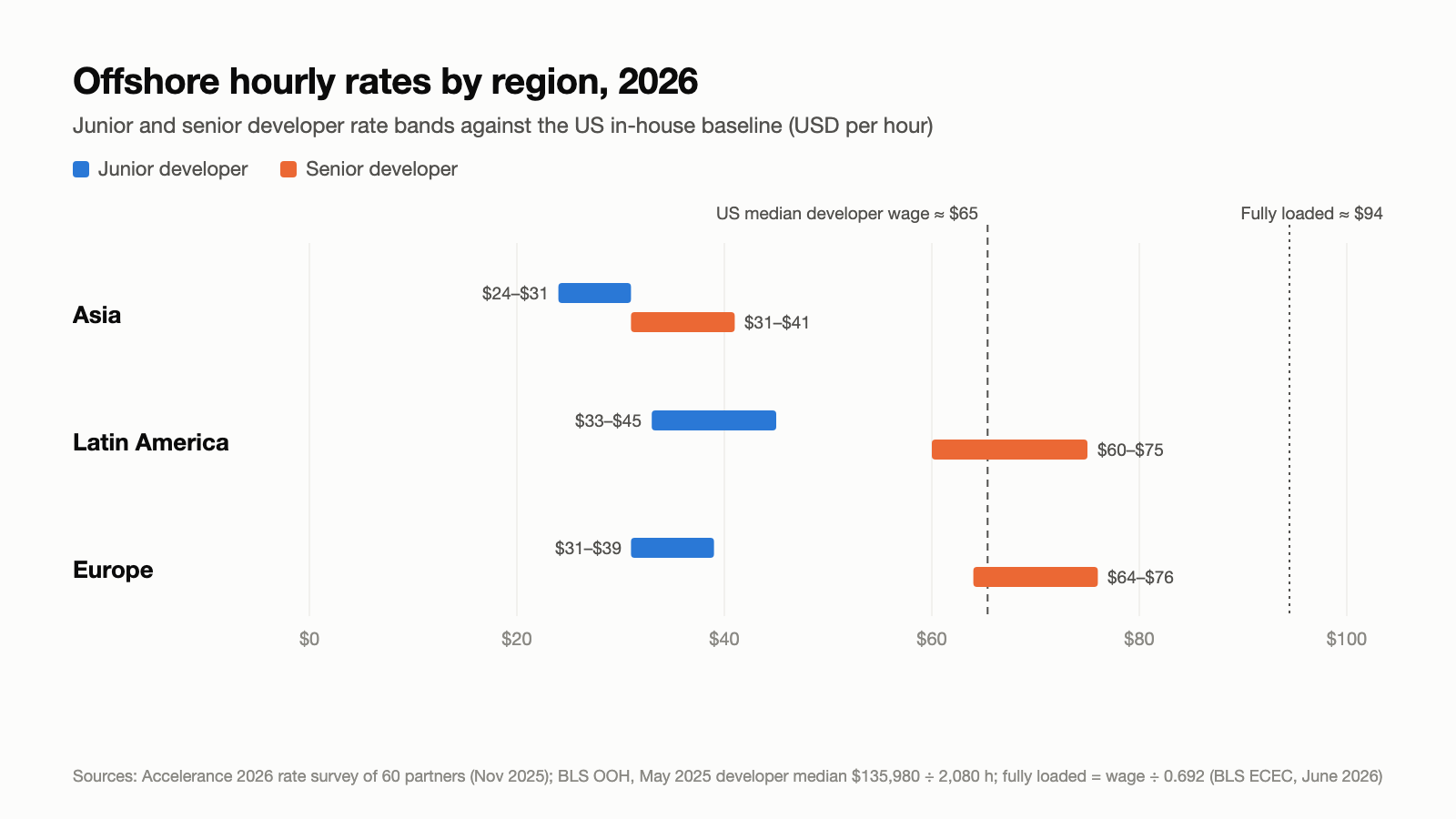
Every quote starts with an hourly rate, so start there. Accelerance, a firm that vets outsourcing partners, surveyed 60 software development partners worldwide for its 2026 rate outlook, published on November 24, 2025 (Accelerance). These are its offshore developer hourly rates by region.
| Region | Junior developer | Senior developer | Change on prior year |
|---|---|---|---|
| Asia | $24–$31 | $31–$41 | Down nearly 8% |
| Latin America | $33–$45 | $60–$75 | Down 7.1% |
| Europe | $31–$39 | $64–$76 | Down 4.4% |
Clutch's pricing guide, based on the software development firms listed on its platform and their client reviews, broadly agrees for Asia and for junior roles. Most software development companies listed on Clutch charge $24 to $49 an hour (Clutch, updated September 2026). Its country bands put India, the Philippines, Ukraine and Mexico at $25 to $49, and Poland alongside the United States at $50 to $99.
The table shows rates falling in every region, which is good news for buyers. But a rate is only the price of an hour. It says nothing about how many hours the work will take, or what it costs you to run the relationship. For the hours behind a whole product, see what it costs to build an MVP offshore, modeled feature by feature.
Offshore developer rates by country
Software firms listed on Clutch in India, the Philippines, Ukraine, Mexico and Spain typically charge $25 to $49 an hour. Poland sits with the United States at $50 to $99. Those bands come from Clutch's pricing guide, updated September 2026 and built from verified client reviews of firms listed on its platform. Country bands are wider than regional ones, so treat them as a first filter, not a quote. The United States, Canada and Australia rows are onshore comparisons. If you are buying from one of them, our pages for the United States, Canada and Australia show how a Kathmandu working day lines up with yours.
| Country | Typical hourly rate |
|---|---|
| India | $25–$49 |
| Philippines | $25–$49 |
| Ukraine | $25–$49 |
| Mexico | $25–$49 |
| Spain | $25–$49 |
| Poland | $50–$99 |
| United States | $50–$99 |
| Canada | $100–$149 |
| Australia | $100–$149 |
Source: Clutch pricing guide (linked above), updated September 2026.
Two things make these numbers harder to use than they look. A band like $25 to $49 covers junior and senior developers together, while Accelerance's regional table above splits them by seniority. And Clutch doesn't publish a band for every country: Vietnam, Brazil, Argentina, Colombia and Nepal aren't on its list. For those, start from the regional bands and ask each vendor for rates by role.
The width of a band matters more than it seems. Say two vendors in the same band quote $30 and $45 an hour for a senior developer. Over the 1,920 billable hours in the worked example below, that's $28,800 a year apart ($15 × 1,920), before any of the costs in the next sections.
The cheapest country can be the wrong choice when your team needs hours of live overlap across time zones every day. It can also be wrong when the work depends on product knowledge that takes months to hand over. Those costs, covered below, can outweigh the difference in rate.
The in-house cost you're comparing against
The US Bureau of Labor Statistics puts the median annual wage for software developers at $135,980 in May 2025, which works out to about $65.38 an hour over 2,080 paid hours. Software quality assurance analysts and testers earned a median of $104,300 (BLS Occupational Outlook Handbook).
Wages are not the employer's full cost. In June 2026, benefits made up 30.8% of total compensation for private-industry professional workers (BLS Employer Costs for Employee Compensation). Dividing the median wage by the 69.2% wage share gives a fully loaded estimate of about $196,500 a year, or roughly $94 an hour1.
That estimate still leaves out recruiting, equipment, office space and software licenses, which the employer also pays.
Costs the rate card leaves out
A contract price covers the vendor's people. The client carries a second set of costs that never appear on the invoice. A study of six offshored projects at a German financial services firm, published in MIS Quarterly in 2008, found that clients bear extra costs for requirements specification and design, knowledge transfer, control, and coordination. Cultural and geographic distance and staff turnover pushed those costs higher (Dibbern, Winkler and Heinzl).
One-time costs
Before work starts, you pay to find, vet and contract a vendor, and then to hand the work over. Handover across time zones is mostly knowledge transfer: your team's time explaining the product, the codebase and the rules nobody wrote down. Earlier research cited in a 2017 IEEE paper estimates that knowledge transfer can add up to 10% to project cost2.
Recurring costs
Once the team is running, someone on your side writes specifications, reviews work, answers questions across time zones and manages the contract. Those hours come from your most expensive people. Most companies have not fully built the function to do this. In Deloitte's 2024 Global Outsourcing Survey of more than 500 executives, 70% said their vendor management office, the team that oversees outside suppliers, was not fully mature (Deloitte).
One early attempt to put percentages on these lines is more than two decades old, but its categories still map onto a modern engagement.
| Line item | Added cost, % of annual contract value |
|---|---|
| Vendor selection and initial travel | 1–10% |
| Transition | 2–3% |
| Layoffs and related costs, if replacing in-house staff | 3–5% |
| Productivity lag from cultural and communication issues | 3–27% |
| Development process improvements | 1–10% |
| Managing the offshore contract | 6–10% |
Source: CIO, "The Hidden Costs of Offshore Outsourcing", September 2003.
Other lines to check
Three more items rarely show up in rate comparisons. Contract and intellectual property review needs a lawyer who knows cross-border work, and the contract decides who owns the code in offshore software work. International payments can carry transfer and currency conversion fees. And a real team needs QA and project management hours alongside the developers, so ask how those roles are staffed and billed.
What a measured case study found
Estimates are common. Measured costs are rare. Researchers from Blekinge Institute of Technology and Delft University of Technology studied a large Swedish corporation that moved ongoing product development to its own newly opened site in India, a so-called captive site rather than an outside vendor. They combined data from corporate archives with expert estimates gathered in focus groups and workshops (Šmite, Britto and van Solingen, IEEE ICGSE 2017; DOI).
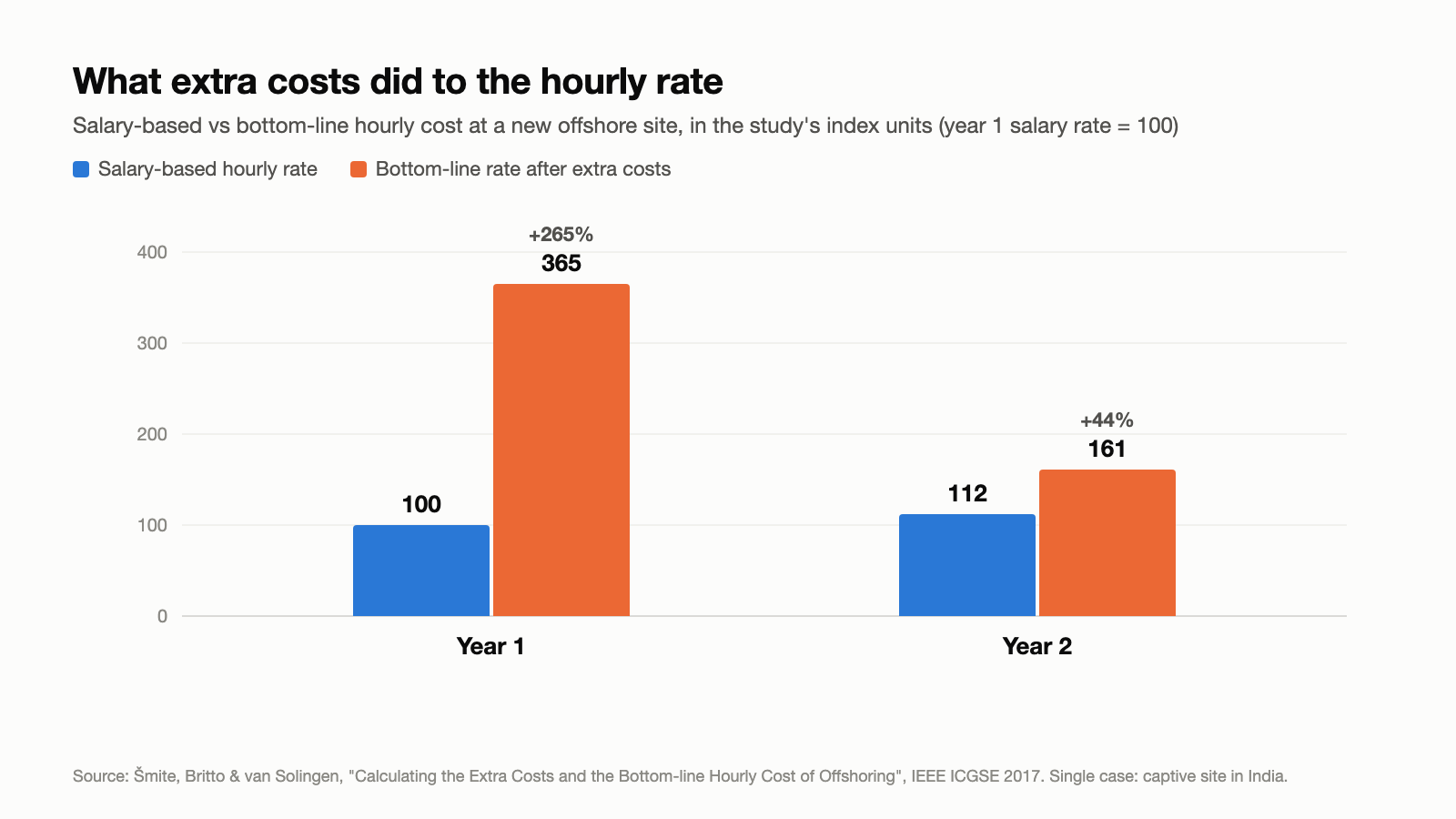
The extra costs were large. In the paper's words, "the extra cost increased the hourly cost by 265 percent in the first year and by almost 50 percent in the second year"3. Averaged over the two years, India's salary-based hourly rate was about a quarter of Sweden's, 106 index units against 404. Once extra costs were added, India's rate rose to 263, so the gap shrank from about four times to about 1.5 times.
Productivity changed the answer again. The study measured output in complexity points, a size estimate for completed work. The company's mature teams completed about 92 points per 1,000 hours, against about 25 for the new offshore teams.
Cost per 100 points was 141 index units offshore in the first year and 66 in the second, against 44 for the mature teams, costed at Swedish salaries4. Even in year two, offshore work cost 50% more per unit. Attrition at the new site was above 30% in both years5.
This is one company, running its own site rather than hiring a vendor, in the first two years of a new location, so the figures will not transfer directly to your project. The lesson does: the rate card measures the price of an hour, not the cost of finished work.
Hourly rates are a poor measure of the true cost of software development.
Attrition: the cost rarely quoted
Every developer who leaves takes product knowledge with them, and their replacement starts at the bottom of the learning curve on your budget. Large IT services firms disclose their turnover in their results, but it seldom appears in a quote.
| Company | Attrition, trailing 12 months | Period | Source |
|---|---|---|---|
| Wipro | 13.9%, voluntary | Quarter to June 2026 | Wipro results |
| Cognizant | 13.9%, voluntary, tech services | Full year 2025 | Cognizant Form 10-K |
Each company defines attrition slightly differently, but both figures mean roughly one person in seven leaving in a year. The case-study site above reported attrition above 30%, on a broader definition that includes internal moves.
The cost of each departure is harder to pin down. Gallup estimates that replacing an employee costs between one-half and two times their annual salary, across all roles rather than developers specifically (Gallup, 2019). Step three of the checklist below covers what to ask a vendor about it.
Seats, tools and licenses
Tooling is small next to salaries but easy to miss, especially when the client supplies the development environment. GitHub's pricing page lists GitHub Enterprise at $21 per user per month for the first 12 months (GitHub). GitHub Copilot Business costs $19 per seat per month and Copilot Enterprise $39 (GitHub Docs).
For a ten-person team, GitHub Enterprise and Copilot Business alone add $4,800 in the first year. Add issue tracking, cloud environments, security tooling and any per-seat licenses your stack needs, and agree in the contract who pays for each.
Fixed price vs time and materials
The pricing model decides who absorbs an overrun. It does not remove any of the costs above.
Time and materials
- You pay for hours worked at agreed rates
- Scope can change without renegotiating the contract
- Estimates that run over are your cost
- Needs active oversight of hours and progress
Fixed price
- The vendor commits to a price for a defined scope
- Overrun risk moves to the vendor, which prices it into the quote
- Scope changes go through change requests
- Suits stable, well-specified requirements
Fixed price is common even at the largest vendors. Fixed-price projects made up 53.6% of Wipro's revenue in the quarter to June 2026 (Wipro Form 6-K).
Worked example: one senior developer, one year
Putting the lines together shows how fast the total moves. This is an illustrative model, not a quote, and it rests on four assumptions:
- A senior developer in Asia at $36 an hour, the midpoint of Accelerance's $31 to $41 band
- 160 billable hours a month, or 1,920 hours a year
- The 2003 CIO ranges applied to that annual contract value, with layoffs excluded
- GitHub Enterprise and Copilot Business seats paid by the client, at first-year pricing
| Line item | Low case | High case |
|---|---|---|
| Rate card: $36 × 1,920 hours | $69,120 | $69,120 |
| Vendor selection and travel (1–10%) | $691 | $6,912 |
| Transition (2–3%) | $1,382 | $2,074 |
| Productivity lag (3–27%) | $2,074 | $18,662 |
| Process improvements (1–10%) | $691 | $6,912 |
| Contract management (6–10%) | $4,147 | $6,912 |
| Tooling seats ($40 × 12 months) | $480 | $480 |
| Total for the year | $78,585 | $111,072 |
On these assumptions, the modeled first-year cost lands 14% to 61% above the rate card. The model counts 1,920 billable hours, while the US salary figure is based on 2,080 paid hours, so the two are not a perfect hour-for-hour match. The CIO percentages were framed for whole outsourcing contracts, so for a single developer, fixed costs such as vendor selection and legal review may take a larger share. Vendor selection and transition are one-time costs, so the second year should come in lower, though tooling may rise once GitHub's first-year pricing ends. Replacement costs from attrition are left out because they depend on who leaves and when.
Even the high case sits well below the roughly $196,500 fully loaded cost of a median US developer, and a senior US hire would cost more still. The case study shows why that comparison is not the end of it. If the offshore team delivers less per hour while it learns your product, the cost per finished feature can still come out higher.
How to get a quote that shows the full cost
A good vendor can answer all of these before you sign. Work through them in order, because each answer changes the next. Price is only half the check: how to vet an offshore development partner covers the questions that test honesty rather than cost. Our FAQ explains how a quote request works with us.
Ask for rates by role and seniority
A blended rate hides the mix. Get junior, senior, QA and project management rates separately, with the expected hours for each.
Ask what the rate includes
Confirm whether project management, QA, DevOps, tooling seats and travel sit inside the rate or are billed on top.
Ask for attrition and replacement terms
Request the vendor's trailing 12-month attrition, the notice period before someone rotates off your team, and who pays to onboard a replacement.
Cost your own team's time
Estimate the hours your product owners and senior engineers will spend on specifications, reviews and calls, and price them at your internal rate.
Budget for the ramp-up
Expect lower output in the first months while the team learns your product, and track cost per delivered feature, not only hours billed.
Offshore development cost questions
How much does offshore software development cost per hour?
Accelerance's 2026 survey put junior developers at $24 to $31 an hour in Asia, $33 to $45 in Latin America and $31 to $39 in Europe. Senior developers ranged from $31 to $41, $60 to $75 and $64 to $76 respectively. Clutch reports that most firms listed on its platform charge $24 to $49 an hour. For buyers in Europe, a Kathmandu working day covers most of your morning: see the United Kingdom, Germany and the Netherlands.
Is offshore development cheaper than hiring in-house?
On the rate alone, usually yes, since a median US developer costs roughly $94 an hour fully loaded. Management time, knowledge transfer, turnover and ramp-up narrow the gap. In one 2017 case study of a company's own offshore site, cost per unit of work was still 50% higher offshore in the second year than at the company's mature teams.
What hidden costs should I budget for in offshore development?
Budget for vendor selection, transition and knowledge transfer up front, then contract management, coordination, productivity lag, attrition and tooling on an ongoing basis. The six 2003 CIO line items range from 1% to 27% of the annual contract value each, or 16% to 65% combined (13% to 60% without layoffs). Attrition and tooling come on top.
Is fixed price or time and materials cheaper?
Neither is cheaper by default. Fixed price moves overrun risk to the vendor, which prices that risk into the quote. Time and materials is more flexible but leaves overruns with you.
How long does it take an offshore team to become cost-effective?
There is no reliable benchmark. In the one measured case above, a company's new site in India still cost 50% more per unit of work than its mature teams in the second year. Plan for the first year to be the most expensive and track cost per delivered feature from the start.
How much does an offshore developer cost?
At $36 an hour, the midpoint of Accelerance's 2026 senior band for Asia, a full-time offshore developer costs about $69,120 a year on the rate card alone. That assumes 1,920 billable hours. The worked example above puts the modeled first-year total at $78,585 to $111,072 once vendor selection, transition, contract management, productivity lag, process improvements and tooling are added. Senior rates in Latin America and Europe run from $60 to $76 an hour.
Which offshore providers publish their engineer rates?
Two widely cited publishers of offshore rate ranges are Accelerance and Clutch, both third parties that pool many vendors. Accelerance publishes regional rate bands from its annual survey of development partners, and Clutch publishes hourly bands by country and by technology for firms listed on its platform. Use those ranges to sanity-check a quote, then ask each vendor for rates by role and seniority, as in the checklist above.
$135,980 ÷ 2,080 hours ≈ $65.38 an hour. $135,980 ÷ 0.692 ≈ $196,500, and $65.38 ÷ 0.692 ≈ $94. The benefits share is the June 2026 average for all private-industry professional occupations, not software developers alone.
↩Šmite, Britto and van Solingen cite this figure from earlier work by C. Ebert on supplier management in global software engineering.
↩In the paper's index units, the hourly cost rose from 100 to 365 in the first year and from 112 to 161 in the second. The second-year rise is 44%, which the authors describe as almost 50 percent. The paper reports costs in a fictional currency to protect confidential salary data.
↩From Table IV of the paper. The productivity comparison uses mature teams across the company's experienced locations; the cost comparison uses Swedish salary data. The authors' own summary puts cost per work unit "almost 60 percent higher" after two years; the table figures give 50% for the second year.
↩Šmite, Britto and van Solingen report attrition "above 30 percent" in both years. They list it alongside developers promoted into non-development roles, moving to other products, or leaving the company.
↩