
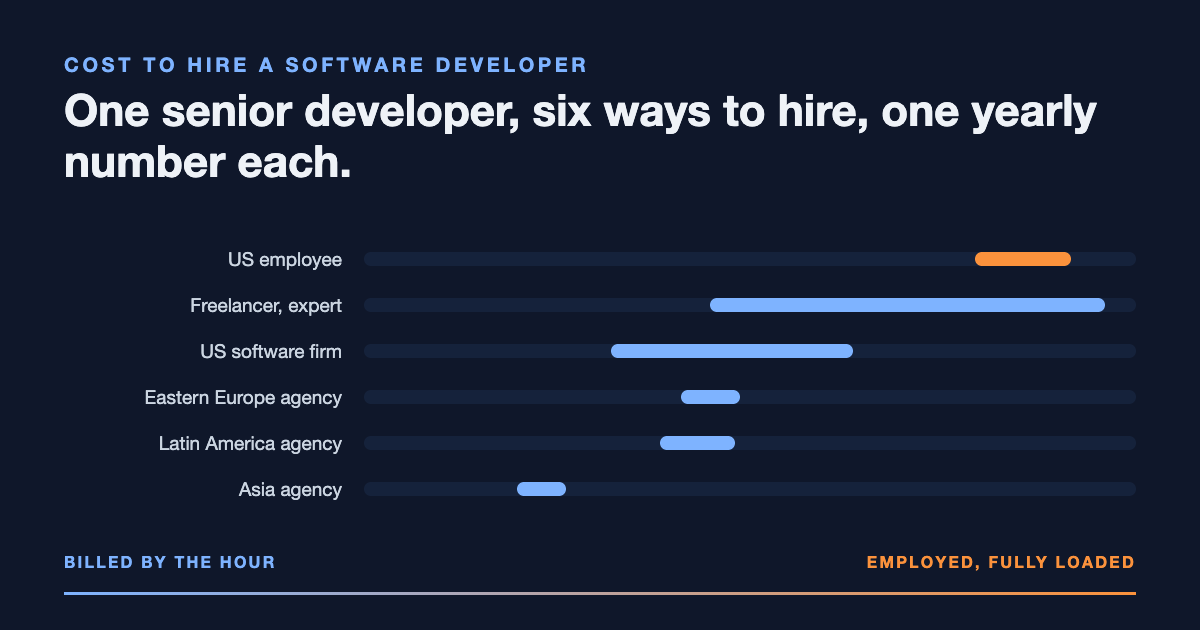
Hiring a senior software developer as a US employee costs about $237,000 in the first year once benefits, recruiting and tools are added to the salary. Through an agency in Asia, the same full-time year costs about $60,000 to $79,000.
Most other routes land in between; an expert freelancer at top rates can cost more. These are estimates from a model built on public data, and this guide shows the arithmetic behind each one.
The hard part is the units. Ask around and you'll hear $35 an hour, $5,000 a month and $250,000 a year. None of those compare until they're the same kind of number. Below, six ways to hire are converted into one: the first-year cost of one full-time senior developer.
Cost to hire a software developer
Hiring one full-time senior software developer costs about $60,000 to $288,000 for the first year, depending on the route you choose (NextraLogic model, estimate). The table below gives one number per route.
"Cost to hire" means two different things. The cost-per-hire is the one-time spend to find someone: job ads, recruiter time, interviews and any recruiter fee. The cost of employment is what having that person costs each year. The second number is much bigger, so this guide counts both and reports the first year.
| Hiring route | How it's priced | First-year cost, one full-time senior developer |
|---|---|---|
| US employee, direct hire | Salary plus benefits, recruiting and tools | $237,275 to $274,795 |
| Freelancer, expert level | $70 to $150+ an hour | $134,400 to $288,000 |
| US software firm | $50 to $99 an hour, all levels | $96,000 to $190,080 |
| Central and Eastern Europe agency | $64 to $76 an hour, senior | $122,880 to $145,920 |
| Latin America agency | $60 to $75 an hour, senior | $115,200 to $144,000 |
| Asia agency | $31 to $41 an hour, senior | $59,520 to $78,720 |
| Employer of record abroad | Local salary plus $599 to $699 a month | Depends on the country |
NextraLogic model, estimate. Hourly routes are the published rate times 1,920 hours (160 a month). Rates come from Upwork (2026), Clutch (September 2026) and Accelerance (2026 rates, published November 2025); EOR fees come from the Deel and Remote pricing pages (2026). The freelancer row excludes any client-side platform fee. The employee row is built step by step in the in-house section below. For more countries, see offshore developer rates by country.
Six routes are priced here. An employer of record, the seventh, adds a fee to a local salary that varies by country.
The ranges are wide because the routes are different purchases. An agency's hourly rate already covers benefits, equipment and margin; a salary covers none of them. That's why every route needs converting before you compare.
Software developer cost by hiring route
Put in the same unit, the routes fall into three groups. An Asia agency costs about $60,000 to $80,000 a year. Most other agencies cost about $100,000 to $190,000. A senior US employee costs about $237,000 to $275,000 in year one. Expert freelancers run from agency prices to above US-employee prices.
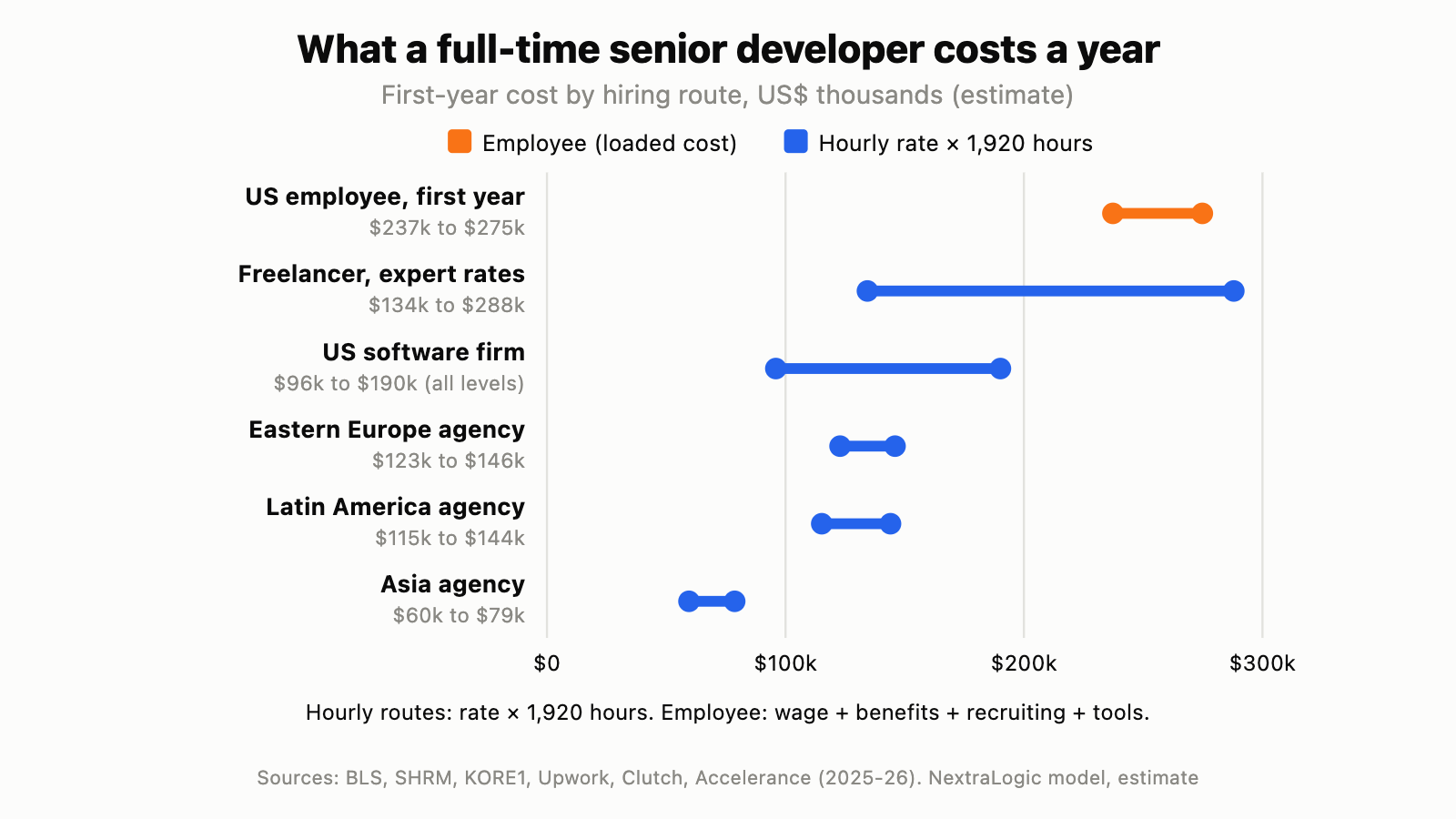
None of these numbers include your own team's time or the months a new developer spends learning your product. Those come further down.
Takeaway: before you compare two options, ask each for one annual figure on the same basis: full time, 12 months, everything billed.
In-house developer cost in the US
A senior US software developer costs about $237,000 in the first year, and the salary is almost three-quarters of it. Benefits, recruiting and tools make up the rest (NextraLogic model, estimate).
Start with pay. The US Bureau of Labor Statistics (BLS) puts the median wage for software developers at $135,980 a year in May 2025. A quarter of developers earned more than $171,980, and a tenth earned more than $214,670 (BLS Occupational Employment and Wage Statistics, 2025). BLS doesn't measure seniority, so this guide uses the 75th percentile, $171,980, as a stand-in for a senior developer.
Next, count the hours. An employee is paid for 2,080 hours a year but works fewer. Say your developer takes 10 vacation days and 8 paid holidays. After a year of service, 32% of private-industry workers get 10 to 14 vacation days (BLS, 2026). Private-industry workers averaged 8 paid holidays in 2025 (BLS, 2026). That leaves 1,936 working hours before any sick days (2,080 − 18 days × 8 hours).
Benefits come next: health insurance, retirement contributions, paid leave and the employer's share of payroll taxes. In June 2026, wages made up 69.2% of total compensation for private-industry professional workers, and benefits the other 30.8% (BLS Employer Costs for Employee Compensation, 2026).
BLS measures these costs per hour actually worked, and it counts paid leave as a benefit. A salary already pays for leave days, so apply the share to the hours worked. That gives about $231,320 a year in pay and benefits ($171,980 × 1,936 ÷ 2,080 ÷ 0.692), or $59,340 on top of the salary.
Then there's the hire itself. The average cost-per-hire was $5,475 across all non-executive roles, not developers alone, in the Society for Human Resource Management's (SHRM) 2025 benchmarking survey of 2,371 members (SHRM, 2025). A recruiting agency costs more. KORE1, a staffing firm, puts direct-hire placement fees at 15% to 25% of first-year salary (KORE1, 2026). On $171,980, that's $25,797 to $42,995.
Tools are small: GitHub Enterprise at $21 a month for the first year (GitHub, 2026) plus Copilot Business at $19 (GitHub Docs, 2026) come to $480 a year.
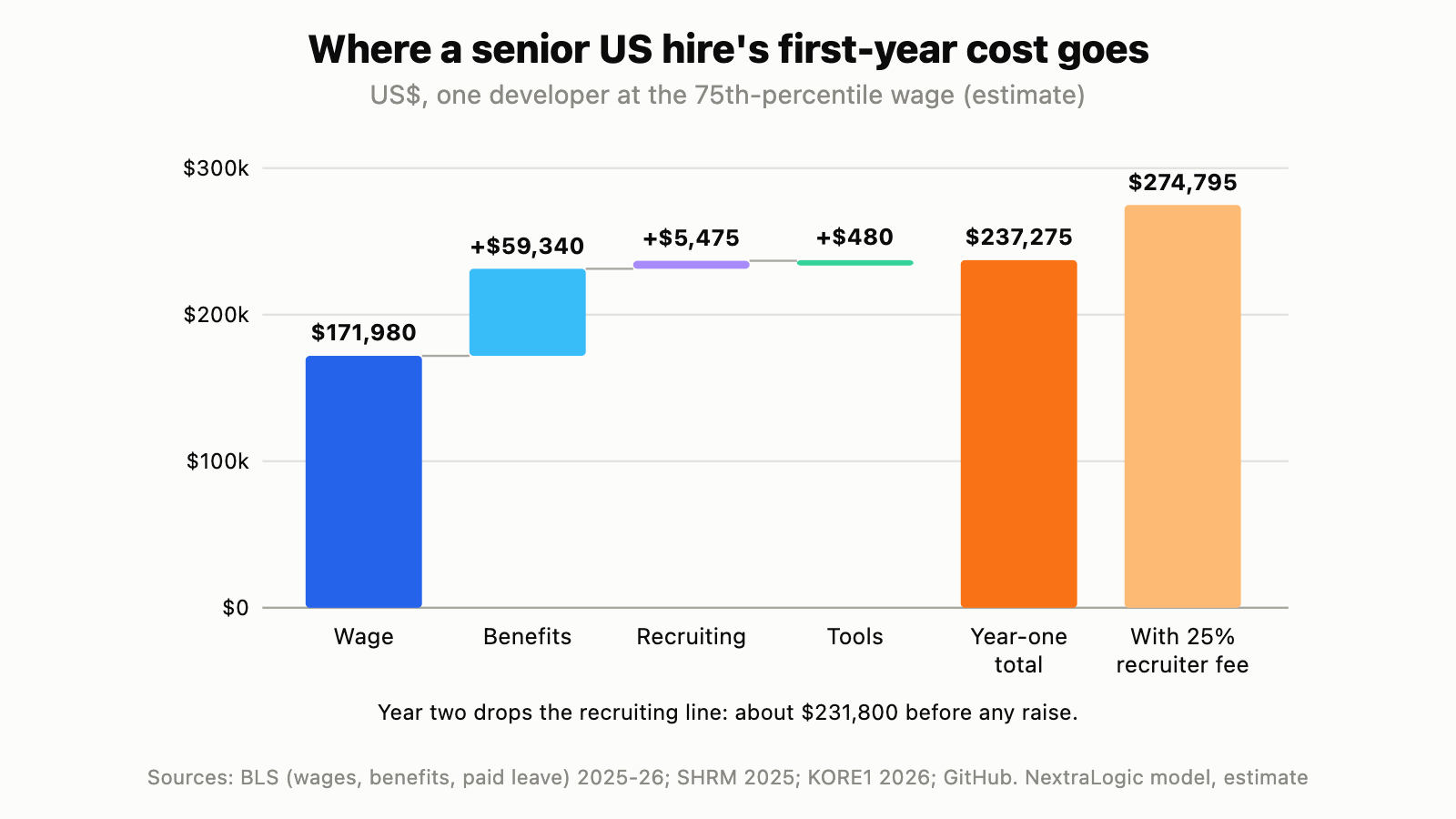
Add it up: $171,980 + $59,340 + $5,475 + $480 = $237,275 for the first year. With a 25% recruiter fee instead of in-house recruiting, it's $274,795. In year two the recruiting line drops out, leaving about $231,800 before any raise or tool-price change.
Per hour actually worked, the first year costs about $123 to $142 ($237,275 or $274,795 ÷ 1,936; estimate). A vendor's invoice, by contrast, counts only the hours worked.
Takeaway: budget a senior US hire at about 1.4 times salary in year one, and ask your finance team for your company's real benefits rate.
What is the average hourly rate for a software developer?
The median US software developer earns $65.38 an hour in wages (BLS, 2025). With benefits added, the employer pays about $94 for each hour actually worked ($65.38 ÷ 0.692). Freelancers and agencies quote a different kind of rate, so check which one you're looking at.
There are three kinds of hourly figure:
- Wage: what an employee receives. That's $65.38 at the US median.
- Loaded cost: what the employer pays per hour worked, benefits and paid leave included. That's about $94 at the median.
- Bill rate: what a freelancer or vendor charges per hour worked. It already covers their own benefits, equipment, sales costs and margin.
Bill rates vary widely. On Upwork, software developers charge $20 to $40 an hour at entry level, $40 to $70 at intermediate level and $70 to $150 or more as experts. Those bands come from historical contracts worldwide (Upwork, 2026). The most common rate band for software firms listed on Clutch is $25 to $49 an hour, and US firms typically charge $50 to $99 (Clutch, 2026).
So a $65 wage and a $65 bill rate aren't the same price. The wage carries benefits on top; the bill rate is the whole price.
Takeaway: before comparing two rates, ask whether each is a wage or a bill rate.
Is it cheaper to hire a freelancer?
Cheaper than a US employee, usually. Cheaper than an agency, often not. A full-time expert freelancer at Upwork's $70 to $150 band costs $134,400 to $288,000 for 1,920 hours (estimate). Below about $124 an hour, that's less than a senior US hire's first year ($237,275 ÷ 1,920; estimate). Against an agency, it usually costs as much or more. The low end matches a senior developer from a Latin American or Central and Eastern European agency, and the high end is double.
What you save is real. There are no benefits, no recruiter fee and no notice period, and you pay only for hours used. Marketplaces take a cut too. Upwork charges freelancers a service fee of 0% to 15% per contract, and its help page shows a freelancer raising their rate to cover it (Upwork Help, 2026). Clients may pay a platform fee as well, so check the marketplace's pricing before you compare.
What you take on is the risk of one person. When a freelancer is sick, booked elsewhere or gone, the work stops and nobody else knows the code. You also become the team lead: reviewing code, testing and deciding what to build next.
Freelancers win on short, specialist or part-time work. Say you need 300 hours on a payment integration. At $100 an hour, that's $30,000, with no hiring cost and no year-long commitment.
Takeaway: price a freelancer for the hours you'll really use, not for a full-time year.
Agency rates: onshore, nearshore, offshore
Onshore means your own country, nearshore a nearby one with overlapping hours (Latin America, for US companies), and offshore a distant one with fewer shared hours.
Senior developers from agencies cost $31 to $41 an hour in Asia, $60 to $75 in Latin America and $64 to $76 in Central and Eastern Europe. Those are the 2026 bands from Accelerance's survey of 60 development partners, published in November 2025 (Accelerance, 2025). Junior developers in Asia cost $24 to $31.
Clutch's country bands, built from firms listed on its platform, give a second view (Clutch, 2026):
- India, the Philippines, Ukraine and Mexico: $25 to $49 an hour
- Poland and the United States: $50 to $99
- Canada and Australia: $100 to $149
A country band mixes junior and senior rates, so ask each firm for rates by role.
An agency rate sits closer to a loaded cost than to a salary, because it already pays the developer's benefits, recruiting, equipment, management and the agency's margin. It still isn't the full cost. As Accelerance's Olivier Poulard put it, rates "are not the same as costs" (Accelerance, 2025). We sell offshore development for US companies ourselves, so check these sources rather than taking our word. For the lines an offshore quote leaves off, see our breakdown of offshore software development cost.
Takeaway: ask every agency for senior and junior rates separately, and for what each rate includes.
Hiring through an employer of record
An employer of record (EOR) is a company that legally employs a worker in the worker's own country on your behalf. It runs payroll, taxes and the local contract while you direct the work. Deel lists its EOR plan at $599 per employee per month (Deel, 2026), and Remote at $699 (Remote, 2026).
That's $7,188 to $8,388 a year per person, on top of the local salary and the employer contributions that country requires. You get a direct employee abroad without opening a company there, but you find, hire and manage them yourself.
Takeaway: price an EOR hire as the local salary, plus the country's employer contributions, plus $7,188 to $8,388 a year in fees.
Costs no rate card shows
Every route carries three costs that never appear on an invoice: ramp-up while a new developer learns your product, your own team's time, and replacing people who leave.
Ramp-up. A new developer is slower until they know your codebase and your customers, whether they're an employee or a contractor. There's no reliable benchmark for how long that takes. Plan for lower output in the first months, and track finished work rather than hours.
Your own time. Someone on your side writes specifications, reviews code and answers questions. Say that's a founder whose time is worth $150 an hour, spending 8 hours a week. That adds $62,400 a year ($150 × 8 × 52) to whichever route you choose.
Turnover. Two of the largest IT services firms, Wipro and Cognizant, each reported 13.9% voluntary attrition, about one person in seven a year (Wipro, 2026; Cognizant, 2025). Cognizant's figure covers its tech services staff. Gallup estimates that replacing an employee costs one-half to two times their annual salary, across all roles (Gallup, 2019).
For an offshore team, these extras can be large. Our cost model adds 14% to 61% to an Asia agency's rate card in the first year, once vendor selection, transition, contract management and productivity lag are counted. The offshore cost breakdown linked in the agency section above shows that arithmetic line by line.
If you'd like a role-by-role estimate to set against your in-house number, ask for one on our free 30-minute scoping call.
Worked example: a $250,000 hiring budget
Say you're a founder with $250,000 a year for engineering. Here's what it buys on each route, using the figures above (estimates):
| Route | Cost per developer, year one | Developers for $250,000 |
|---|---|---|
| US employee | $237,275 | 1.05 |
| Latin America agency, $67.50 an hour | $67.50 × 1,920 = $129,600 | 1.9 |
| Asia agency, $36 an hour, rate card only | $36 × 1,920 = $69,120 | 3.6 |
| Asia agency, with modeled extras | $78,585 to $111,072 | 2.3 to 3.2 |
The hourly figures are the midpoints of Accelerance's senior bands. The modeled extras come from the first-year cost model in our offshore cost breakdown.
A small team works the same way. Two senior and two junior developers from an Asia agency, at band midpoints, cost $243,840 a year on the rate card. That's 2 × $69,120 for the seniors plus 2 × $52,800 ($27.50 × 1,920) for the juniors.
What the table can't tell you is output. Three developers who need weeks of explanation can ship less than one who already knows the product. For what those hours produce, see what it costs to build a minimum viable product (MVP) offshore, modeled feature by feature.
Takeaway: after three months, compare cost per finished feature, not cost per hour.
When the cheapest route is wrong
The cheapest rate is the wrong choice in five situations:
- The work is your core product. The knowledge behind it is hard to write down, and an employee who stays for years keeps it in the company.
- You need hours of live conversation every day. Asia's time zones leave US teams few hours of live overlap.
- Nobody on your side can specify and review. Any outside team, at any rate, drifts without that.
- The job is small and specialist. A 200-hour task rarely justifies an agency's onboarding, so a freelancer usually fits better.
- A customer contract or regulation limits where data can go. Check it before choosing a country.
In each case, paying more per hour can cost less per result.
How to choose a hiring route
Work through these five steps in order. Each answer narrows the next.
Count the hours
Full time for a year and 300 hours for one feature point to different routes.
Turn every option into one annual number
Use 1,920 hours for vendors and the full loaded cost for employees.
Ask what each number includes
Check benefits, project management, QA (testing), tools and who pays to replace someone who leaves.
Price your own team's time
Add the hours your people will spend specifying and reviewing.
Test before you commit
Start with a small paid milestone and measure finished work. Our guide on how to vet an offshore development partner lists questions that get honest answers.
Software developer cost FAQ
How much does it cost to hire a software developer in India?
Clutch's rate band for Indian software firms is $25 to $49 an hour (Clutch, 2026). Full time at 1,920 hours, that's $48,000 to $94,080 a year (estimate). Accelerance's 2026 band for senior developers across Asia is $31 to $41 an hour.
How much does it cost to hire a software development team?
Multiply each role's hourly rate by its hours, then add any roles billed separately, such as QA (testing) or project management. Two senior and two junior developers from an Asia agency cost $243,840 a year on the rate card, at the midpoints of Accelerance's 2026 bands (estimate).
How much does it cost to hire an app developer?
App developers are priced on the same routes and rate bands as other software developers. BLS describes software developers as people who "design computer applications or programs" (BLS Occupational Outlook Handbook, 2026), so the $135,980 median wage above covers them (BLS, 2025). Ask each vendor for rates by role and platform.